
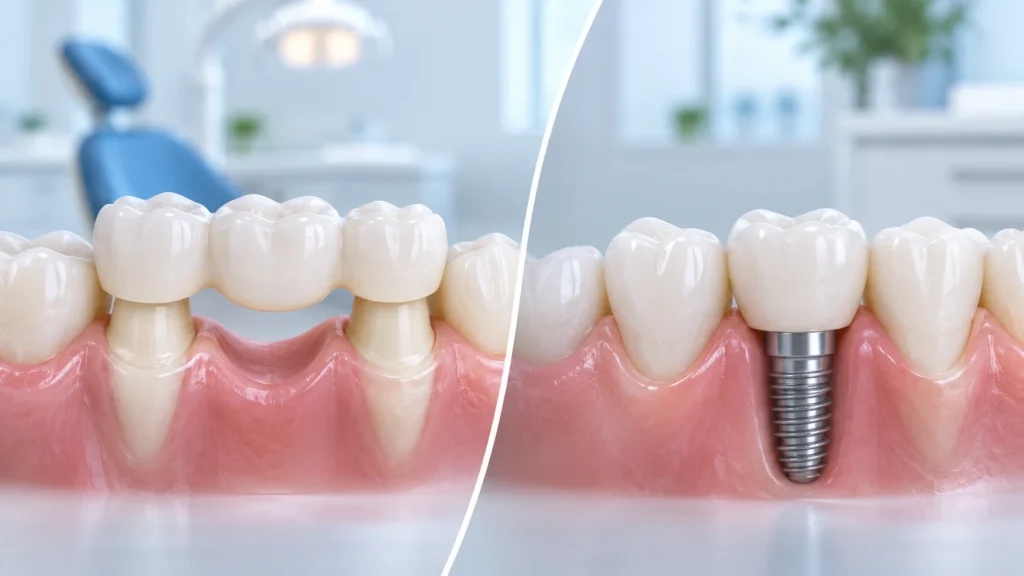
If you are missing a tooth, deciding between a dental bridge vs implant can feel overwhelming. Both treatments can replace a missing tooth and improve your ability to chew and smile, but they work differently. A conventional dental bridge is supported by nearby teeth. A dental implant is placed in the jawbone and supports a replacement crown after healing.
The better option depends on the health of your neighboring teeth, your jawbone and gums, your medical history, your budget, and how quickly you want treatment completed. This guide compares the procedures, dental implant vs bridge cost, benefits, limitations, recovery, and long-term maintenance so you can have an informed discussion with your dentist.
Quick answer: A bridge is often completed sooner and generally involves no implant surgery, but it usually requires shaping neighboring teeth. An implant typically takes longer and may have a higher initial cost, yet it can replace a tooth without using adjacent teeth for support. Neither is universally best. [1–3]
Dental Bridge vs. Implant: Side-by-Side Comparison
| Factor | Conventional dental bridge | Single dental implant |
| What replaces the tooth? | One or more artificial teeth attached to adjacent natural teeth | A post in the jaw supporting a crown; implants can also support bridges |
| Nearby teeth | Conventional bridges usually require preparing support teeth | Single-tooth implant generally leaves neighboring teeth untouched |
| Procedure | Dental preparation, impressions/scans and placement | Surgical placement, healing and crown attachment |
| Treatment time | Often a shorter sequence of visits; case-dependent | Often several months; additional grafting may lengthen timeline |
| Bone support | Does not replace the missing tooth root | Transfers function through the jawbone and helps preserve bone |
| Maintenance | Clean underneath the bridge and around supporting teeth | Brush, clean around the implant and attend ongoing reviews |
| Cost | Often lower upfront, varies by design and other work | Often higher upfront, varies with imaging, grafts, surgery and crown |
This compares a conventional tooth-supported bridge with a single implant and crown. Maryland bridges and implant-supported bridges have different designs.
What Is a Dental Bridge?
A dental bridge fills a gap with one or more replacement teeth (pontics). In a traditional fixed bridge, crowns or other retainers on teeth next to the gap hold the replacement tooth in place. The dentist evaluates those support teeth, prepares them if needed, records the fit, and attaches the restoration when it is ready. Fixed bridges are not taken out by the patient. [2]
When Might a Bridge Make Sense?
- The neighboring teeth already have large fillings or need crowns, so using them as supports may fit the broader treatment plan.
- You prefer to avoid implant surgery or medical factors make an implant less suitable.
- You want to discuss a potentially shorter treatment timeline or lower initial cost.
Potential trade-offs include removing healthy tooth structure in a conventional bridge, plaque retention if cleaning is inadequate, and future repairs if a support tooth develops decay or periodontal problems. Your dentist should discuss the bridge design and whether the neighboring teeth can reliably support it.
What Is a Dental Implant?
A dental implant is an artificial tooth root, commonly made of biocompatible materials, surgically placed into the jaw. After it bonds with the surrounding bone (osseointegration), a connector and custom crown can restore the missing tooth. This approach typically does not require shaping healthy teeth next to the gap. [1, 3]
Who May Be a Dental Implant Candidate?
A dentist evaluates gum health, available jawbone, oral hygiene, overall health and medications. Untreated gum disease, smoking, some medical conditions and inadequate bone may affect healing or require additional treatment. Being older does not automatically rule out an implant; individual health and anatomy matter more. [3]
For more about eligibility, see our planned related guide, “Are You a Candidate for Dental Implants?” (add a link only once that article is published).
Dental Implant vs. Bridge Cost: What Are You Paying For?
The dental implant vs bridge price difference is important, but a single advertised price rarely shows the full treatment cost. A bridge quote may include the number and material of units, scans or impressions, temporary restoration, and treatment required for the supporting teeth. Implant treatment can include an examination, imaging, extraction, bone grafting where necessary, surgical placement, abutment, crown, and follow-up visits.
Is a Dental Bridge Cheaper Than an Implant?
A conventional bridge frequently has a lower initial cost than a single implant with a crown, particularly when no complex preparation is needed. But that is not a fixed rule. If a support tooth needs treatment or a bridge eventually needs replacement, long-term costs may change. Similarly, an implant with grafting or other additional procedures can cost more than a straightforward implant.
Ask for written, itemized estimates for both options rather than relying on a national average or a “starting at” price. Kalorama Dental Arts has not supplied verified treatment prices for this article, so no dollar amounts are quoted.
Does Dental Insurance Cover Bridges or Implants?
Many dental plans distinguish between examinations, extractions, prosthetic restorations and implant surgery. Coverage can vary based on the policy, waiting periods, annual maximum, missing-tooth clauses, preauthorization requirements and whether a provider participates in the network. An insurer may cover some components of treatment but not others.
Before choosing, ask your practice for the procedure codes and an estimate, then contact your insurer to confirm benefits and expected out-of-pocket costs. Do not assume that either option is fully covered or excluded.
Dental Bridge vs. Implant Pros and Cons
Advantages and Limitations of Dental Bridges
- Advantages: fixed replacement, often a shorter treatment process, and a useful solution when neighboring teeth would benefit from crowns.
- Limitations: conventional designs depend on support teeth; cleaning beneath the replacement tooth requires care; they do not replace the missing root.
Advantages and Limitations of Dental Implants
- Advantages: independent support for a single tooth, no need to prepare healthy adjacent teeth, and support for bone preservation around the missing tooth site. [1]
- Limitations: surgery, eligibility and healing considerations, potentially higher initial expense, and ongoing maintenance. Implant failure and inflammation around implants are possible.
Which Lasts Longer: Dental Bridge or Implant?
Both restorations can serve patients for many years, but no dentist can promise a set lifespan. A bridge may need replacement because of wear, decay in an anchor tooth, periodontal changes or failure of its cement or framework. An implant can remain stable for a long time, but its crown may need repair or replacement, and inflammation or bone loss can threaten the implant if care is inadequate. [1, 4]
Avoid interpreting “implant lasts forever” as a guarantee. The health of your mouth, bite forces, smoking status, hygiene and follow-up care are more useful considerations than any single lifespan claim.
Procedure, Pain and Recovery: What Should You Expect?
Dental Bridge Procedure and Recovery
For a conventional bridge, the dentist usually prepares support teeth, takes scans or impressions, and places a temporary restoration if needed. You may have short-term tenderness or sensitivity after tooth preparation. A permanent bridge is fitted when ready. Timelines vary by case and laboratory workflow.
Dental Implant Surgery and Healing
An implant is placed with appropriate anesthesia. Soreness, swelling or bruising may occur afterward; the soft tissues often settle earlier than the bone. Bone integration commonly takes several months, and some patients need additional procedures or a temporary replacement during healing. Specific timeframes depend on the treatment and healing response. [3, 5]
Neither treatment should be described as universally painless. Ask your dentist about anesthesia, postoperative instructions, how discomfort is managed, and the symptoms that should prompt an urgent call.
What About Bone Loss and Neighboring Teeth?
After tooth loss, the jawbone around the missing root can gradually resorb. A conventional bridge restores the visible tooth without replacing the root. An implant placed into suitable bone can help maintain that local bone support, although it does not guarantee that no bone changes will occur. [1]
When your neighboring teeth are healthy, preserving their natural structure may favor an implant. If they are already damaged or need crowns, a bridge might be reasonable. The best choice relies on a full examination rather than a rule applied to everyone.
How to Decide: A Practical Tooth-Replacement Checklist
- Are the teeth next to the gap healthy, or do they need crowns or other treatment?
- Do you have enough jawbone and healthy gums for an implant, or would extra treatment be needed?
- Are you comfortable with surgery and a potentially longer treatment timeline?
- What are the separate upfront estimates, insurance benefits and possible future maintenance costs?
- How will each option affect cleaning, comfort, appearance and your bite?
- Are you replacing one tooth or several teeth? An implant-supported bridge may be another option for multiple missing teeth.
A dentist can help weigh these factors against your priorities. If you are not eligible for an implant today, ask whether gum treatment, bone grafting, a bridge or a removable partial denture would be appropriate.
Discuss Tooth Replacement Options in Washington, DC
If you are considering a dental bridge vs implant in Washington, DC, Kalorama Dental Arts can help you take the first step by contacting the practice to discuss your dental concerns and request an appointment. Ask the office which restorative services and implant evaluations are currently available and whether a specialist referral is needed. A personalized recommendation requires a clinical examination and, when appropriate, imaging.
Learn about Kalorama Dental Arts – https://kaloramadental.com/
Request an appointment – https://kaloramadental.com/contact-us/
Dental Bridge vs. Implant: Frequently Asked Questions
Is a bridge or implant better for one missing tooth?
An implant may be preferable when neighboring teeth are healthy and you are a suitable surgical candidate. A bridge may be attractive when adjacent teeth already need crowns or an implant is not appropriate. Your dentist should examine the area before advising.
How long does a dental bridge last vs an implant?
Both can last many years. Bridges depend on the health of supporting teeth; implants depend on healthy supporting tissues and continued maintenance. Crowns and bridge components may need repair or replacement over time.
Can you get a dental implant years after losing a tooth?
Possibly. Bone may have diminished since the tooth was lost, so imaging and an examination determine whether an implant is possible or grafting is needed.
Does a bridge damage the teeth next to the gap?
A conventional bridge requires preparing adjacent teeth, which removes some tooth structure. This is an important consideration when those teeth are otherwise healthy. Other bridge designs may involve less preparation but are not right for every situation.
Which option looks more natural?
Both can look natural when designed appropriately. The appearance depends on gum and bone contours, tooth position, materials, and the clinician’s restorative plan.
Can insurance pay for dental implants or bridges?
Coverage depends on the specific dental plan and treatment codes. Request a written estimate and ask the insurer about covered components, exclusions, waiting periods and annual benefit limits.
A Final Word: Choose the Treatment That Fits Your Mouth
A bridge and an implant can both replace missing teeth, but they solve the problem differently. Consider the health of adjacent teeth, available bone, treatment time, maintenance and your full costs-not simply the procedure with the lower advertised price. A clinical evaluation is the right next step toward a plan that suits your needs.
Contact Kalorama Dental Arts to request an appointment
Medical notice: This article is general educational information, not individualized medical advice. A licensed dental professional must assess your health and provide treatment recommendations.